| NIES-MCC | KU-MACC | Tree to Strain | Japanese | English |
| Life / Eukarya | |
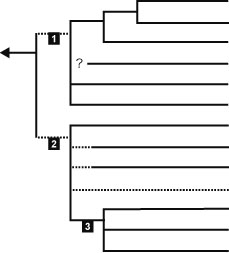
|
Opisthokonta (Metazoa, choanoflagellates, Fungi etc.) |
|
* Dotted lines indicate they may be non-monophyletic 1. Unikonta 2. Bikonta (= Plantae sensu Nozaki et al. 2007) 3. Harosa (= SAR clade) |
|
| Refereces |
|
|
The most multicellular organisms, such as animals, mushrooms and land plants, are eukaryotes. Many unicellular eukaryotes such as yeasts, ciliates, amoebae and diatoms, are also present. Eukaryotes are composed of eukaryotic cell(s), in which the linear DNA form nucleosome/chromatin with many proteins and are located in the nucleus surrounded by double membranes (nuclear membrane). Thus the locations to transcribe and translate are divided in eukaryotes. All eukaryotes (probably) possess mitochondria or homologous organelles via endosymbiosis with α-proteobacteria like organism. Eukaryotic cells are also different from prokaryotic cells in the presence of developped membraneous organelles such as endoplasmic reticulum and Golgi body. Eukaryotes are basically heterotrophic, but the common ancestor of the Plantae acquired the chloroplast via endosymbiosis with a cyanobacterium. This photosynthetic organelle was transferred to various eukaryotes via secondary and tertiary endosymbioses. Recent molecular phylogenetic studies show that there are some supergroups (e.g. Opisthokonta, Amoebozoa, Rhizaria, Alveolata) in the Eukarya. However, the interrelationships beteen these supergroups have not been clarified. |
 1: Vanella (Amoebozoa). 2: unidentified foraminifer (Rhizaria). 3: Cryptomonas (Hacrobia). 4: Ceriodaphnia (Opisthokonta). 5: Scytosiphon (Stramenopila). 6: Sedum (Plantae). 7: Paramecium (Alveolata). 8: Phacus (Excavata). |